Anyone choosing information security and compliance software for the first time usually compares feature lists. These look much the same at almost every vendor. The differences only show up in daily use: when a second framework is added, when the auditor wants to see documents or when a piece of evidence expires. The ten criteria below help you spot those differences before you buy.
A note up front: Sightadel is itself such a product. That is why we have phrased the criteria so that you can apply them to every vendor in the same way.
First question: do you need a platform at all?
Not every company needs a specialised platform. A well-kept document repository with a clear folder structure and a spreadsheet for measures is often enough if the following applies:
- You implement exactly one framework, and a second is not on the horizon.
- One or two people maintain everything, and both are likely to stay.
- Customers rarely ask for evidence, and questionnaires are the exception.
- There are no suppliers whose security you have to assess regularly.
A platform pays off as soon as several frameworks come together, several departments contribute or evidence has to be renewed regularly. At that point, maintaining spreadsheets quickly becomes more work than the software.

The ten criteria
1. Frameworks today and in two years
Work out which frameworks you need now and which are likely to follow, such as NIS2 after ISO 27001 or DORA for a customer in financial services. Also check whether you can model your own requirements, for example group policies or a major customer’s specifications.
2. One piece of evidence for several requirements
Many requirements overlap. Good software stores a piece of evidence once and maps it to every matching requirement. If you keep a copy for each framework, you soon end up with different versions.
3. Evidence with an expiry date
A restore test or a training list does not stay valid forever. Ask about versions, validity dates and a reminder before expiry. Plain file storage cannot do this.
4. Guidance rather than empty templates
Ask how the software guides you through a requirement. A list of 93 controls with an upload field per row is of little help if nobody knows what is meant. Decisions on risks and objectives must still stay with you.
5. Roles and permissions
Who may see and change what? Separate roles for external consultants and for the auditor matter. Read-only access for the auditor saves sending files by email.
6. Supplier assessment
NIS2, DORA and ISO 27001 require you to consider risks in the supply chain. Check whether suppliers can be rated by risk and whether changes to that rating are recorded.
7. Traceability
Every change to a measure or a piece of evidence should be logged with person and time. In an audit, this is often one of the first questions.
8. Reporting for management
Management needs to understand the status without clicking through control lists. What is needed is an overview showing progress, open items and deadlines.
9. Integrations, in moderation
Connections to ticketing systems or cloud accounts save work if you really use those systems. Ask about the integrations you need today. A long wall of logos says little about whether the one integration that matters to you works well.
10. Data location, exit and total cost
Ask where the data is stored, who operates the servers and how you get your data back out. Cost is not just the licence. Include rollout, training and the internal time for maintenance, and check how the price changes when a framework is added.
The scoring matrix
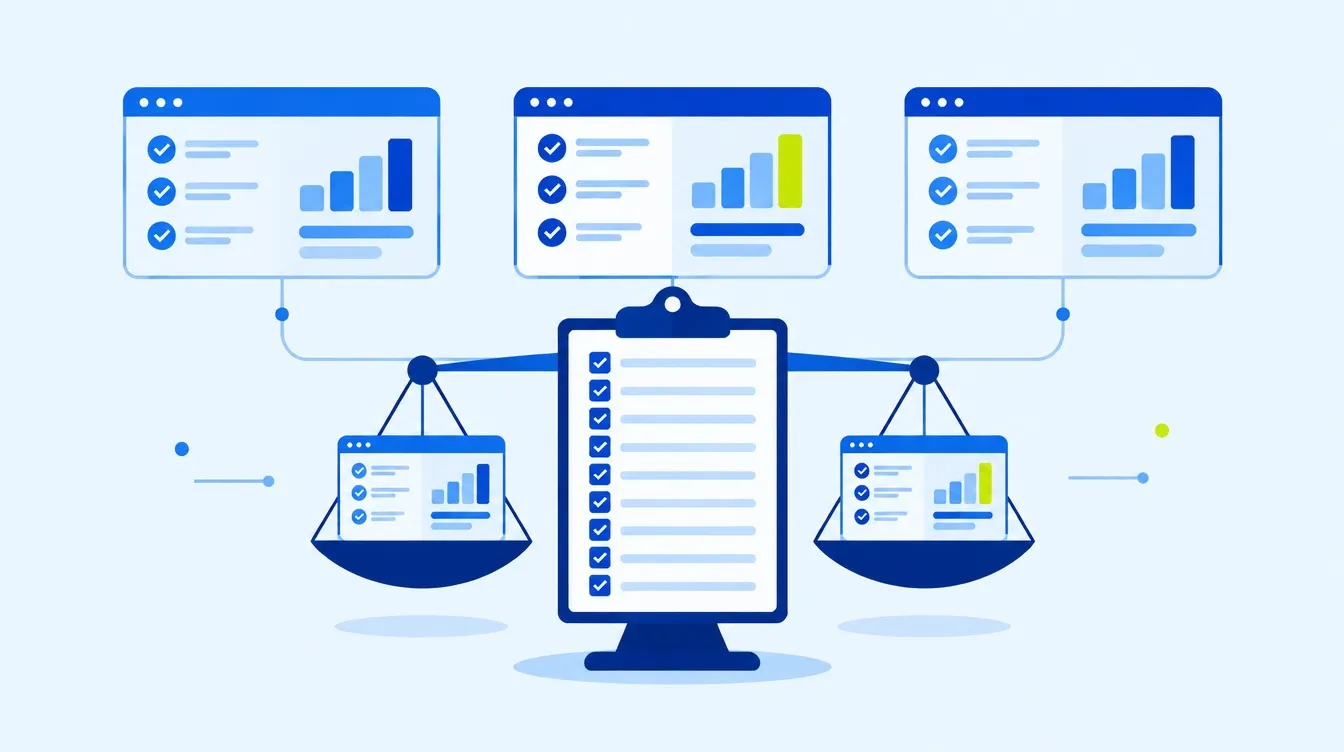
Weight the criteria according to your situation before you look at vendors. Otherwise the vendor with the best presentation wins. Assign a weight from 1 (minor) to 3 (decisive), then score each vendor from 0 (missing) to 3 (fully met) and multiply the two values.
| Criterion | Weight | Vendor A | Vendor B | Vendor C |
|---|---|---|---|---|
| 1. Frameworks today and in two years | ||||
| 2. One piece of evidence for several requirements | ||||
| 3. Evidence with an expiry date | ||||
| 4. Guidance rather than empty templates | ||||
| 5. Roles and permissions | ||||
| 6. Supplier assessment | ||||
| 7. Traceability | ||||
| 8. Reporting for management | ||||
| 9. Integrations | ||||
| 10. Data location, exit, total cost | ||||
| Total |
Ask to see the three most important criteria in a demo using your own example rather than prepared data. A trial account into which you load a real piece of evidence from your company tells you more than any slide.
How Sightadel handles the criteria
- ISO 27001, NIS2, DORA, GDPR, ISO 9001, BSI C5 and other frameworks are built in. You can create your own frameworks.
- Evidence is stored once and mapped to several frameworks, with version, validity date and reminder.
- Suppliers are rated by inherent risk and residual risk.
- Action plans have an owner and a deadline, and every change is logged.
- Auditors and consultants work in the account with their own roles.
- Sightadel is developed and hosted in Germany. Your data can be exported.
For an overview of other vendors, see our vendor comparison. You can try Sightadel free for 14 days or book a demo.
As of: 13 October 2026 · Not legal advice. The standard or law in its current version is authoritative.